Dr. Gymbro
←

#mental fatigue

2 articles
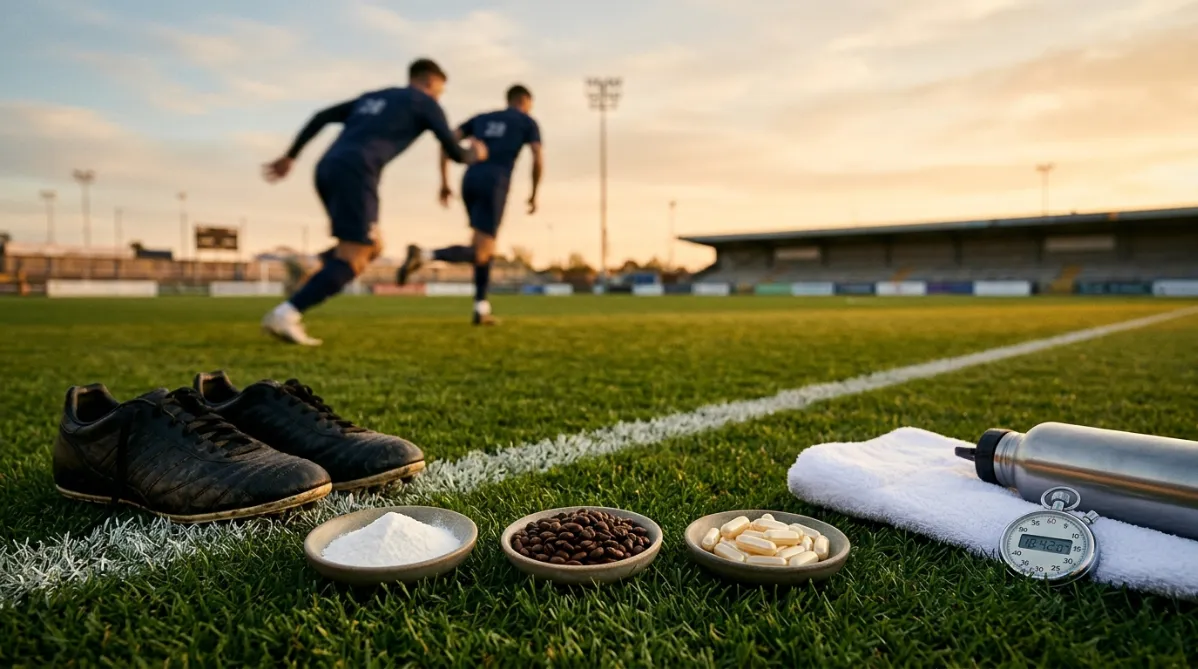
A wide, editorial-style photograph of a professional soccer pitch at golden hour, shot from a low angle at the edge of the grass. In the foreground, slightly off-center to the left, a pair of worn leather cleats sits beside a scatter of three small matte ceramic dishes. One holds fine white taurine powder, one holds dark roasted coffee beans, and one holds pale cream-colored softgel capsules. Soft warm light catches the textures: the grain of the beans, the powder's fine crystalline sheen, the glossy curve of the capsules. A clean white sports towel and a brushed-steel water bottle rest nearby, with a small stopwatch lying on the turf, its face softly glowing.

Behind them, the field stretches into a gentle blur. A lone player in a muted navy training kit mid-sprint leaves a faint streak of motion across the frame, with painterly bokeh from stadium floodlights and distant stands. The grass is a rich, deep green with crisp white line markings curving across the midground and leading the eye toward the athlete. Long amber shadows stretch across the pitch, and a hazy peach and pale blue sky fills the upper right, leaving open negative space for a title overlay.

The palette is restrained and modern: deep green, warm cream, soft amber, charcoal, and a touch of muted coral. The depth of field is shallow, with sharp detail on the supplements and cleats. The mood is calm, premium, and scientific without feeling clinical, like a contemporary sports-science magazine or wellness journal cover. The lighting is natural and cinematic, with gentle film grain and a subtle vignette. The composition follows the rule of thirds, with clean lines and no text, logos, or clutter.
nutrition

Taurine, Caffeine + PS Stack Gave Pro Soccer Players an Edge. The Catch?

BY DR. GYMBRO ·

Pro footballers who took taurine, caffeine and phosphatidylserine for 14 days showed more favorable 30 m sprint results, reaction times and mental fatigue scores than placebo in a 97-player randomized trial. But doubling the PS dose from 300 to 600 mg made only a modest, inconsistent difference. The authors also say the data do not prove better fatigue resistance, and PS was never tested on its own. Here is what the stack was, what it did and what it cannot tell you.
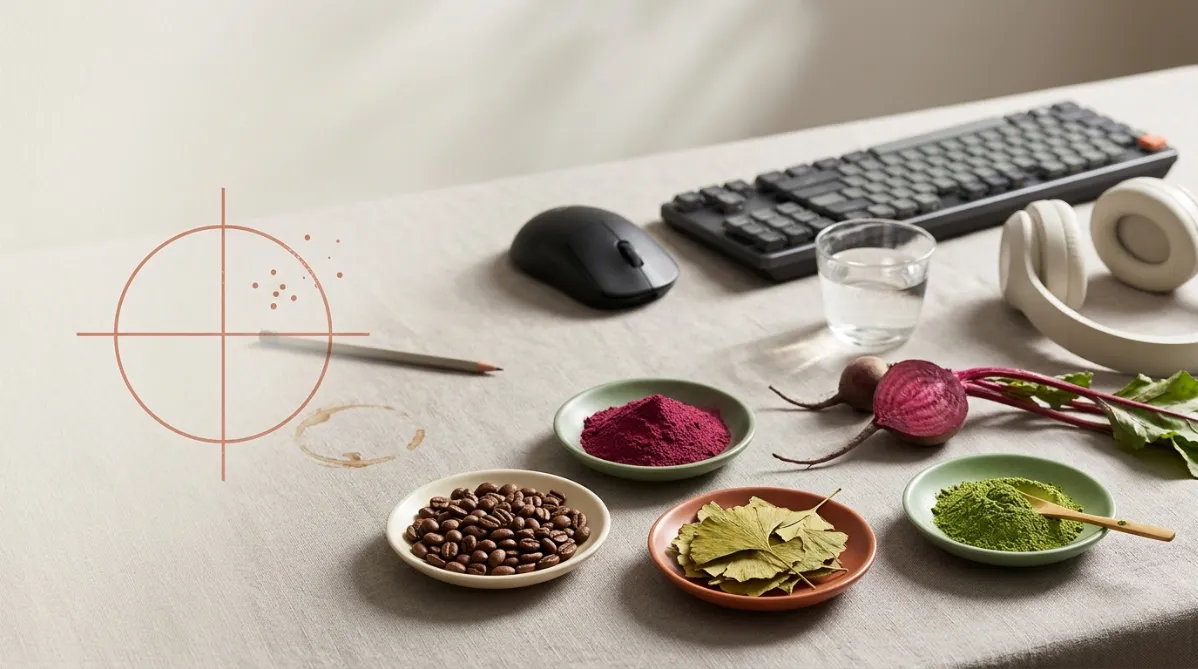
A landscape editorial still life on a softly textured warm-gray linen surface, shot from a slightly elevated three-quarter angle in diffused natural window light. In the foreground, four small ceramic dishes are arranged in a gentle arc. One holds roasted coffee beans, one holds deep magenta beetroot powder, one holds dried golden-green Ginkgo biloba leaves, and one holds bright jade matcha-style green tea powder with a tiny bamboo scoop. Each dish has a distinct, saturated color that stands out against the muted backdrop. Behind them, slightly out of focus, sits a minimalist matte-black gaming mouse beside a sleek, low-profile mechanical keyboard. A pair of matte off-white headphones rests on the right. A single fresh beetroot with its leafy stem and a halved beet showing concentric magenta rings lie casually near the dishes. A small glass of water catches the light, casting soft refracted highlights across the linen.

On the left, a clean, graphic crosshair motif is rendered as a thin circle and cross lines in soft terracotta ink, as if stamped on the paper surface, with a few tiny scattered dots clustered just off-center to hint at drifting aim. A subtle ring of coffee residue and a pencil lie near it, suggesting a researcher's desk. The color palette is warm and earthy: cream, sage green, terracotta, deep beet magenta, charcoal black, and touches of gold. The shallow depth of field gives creamy bokeh in the background, with soft shadows falling to the left. The mood is calm, modern, and intelligent, like a premium health and performance magazine cover, with generous negative space on the upper left for headline text. The composition is balanced and uncluttered, with crisp detail on the ingredients, fine natural textures like leaf veins and powder grain, and a refined, trendy editorial feel. There are no people, no text, and no futuristic elements.
nutrition

Fried Brain, Lost Aim: Which Supplement Actually Restores It?

BY DR. GYMBRO ·

Three hours into ranked, your crosshair drifts and your flicks land just off target. A new crossover trial in 20 high-level FPS players put caffeine, beetroot nitrate, Ginkgo biloba and green tea catechins head-to-head after Stroop-induced mental fatigue. All four beat placebo for shooting accuracy recovery, with no differences among them, while caffeine, nitrate and catechins also restored shooting stability. None improved spatial localization or multitasking beyond natural recovery. Here's how to use the findings, and why the small sample demands caution.

This page is available in